What language do they speak in taiwan

 🔥 Trending News
what language do they speak in taiwan
Taiwan is a linguistically rich and complex society. While a simple answer often points to Mandarin Chinese, the full picture involves multiple Sinitic languages, indigenous Austronesian languages, and evolving language policies shaped by centuries of migration, colonial rule, political change, and democratization. Understanding the languages spoken in Taiwan requires looking at history, demographics, official status, everyday use, and current revitalization efforts.
The Dominant Language: Taiwanese Mandarin (Guoyu)
The language most people encounter first in Taiwan is Mandarin Chinese, known locally as Guoyu (國語, “national language”). It functions as the de facto official language of government, education, media, courts, and public life. Nearly the entire population is fluent in it, and it serves as the common lingua franca across ethnic groups.
Taiwanese Mandarin is based on the Beijing dialect but has developed distinct features due to historical influences and contact with other local languages. Pronunciation differences exist (for example, certain retroflex sounds are often softened or absent), vocabulary includes unique terms or preferences influenced by Taiwanese Hokkien and Japanese loanwords from the colonial period, and Taiwan uses traditional Chinese characters rather than the simplified characters employed in mainland China. These differences mean that while speakers from Taiwan and mainland China can generally communicate, the varieties are not identical.
Mandarin’s dominance is relatively recent in Taiwan’s long history. It was not the everyday language of the majority before the mid-20th century. Its rise is tied to the arrival of the Republic of China government after World War II and the subsequent promotion of a single national language.
Taiwanese Hokkien (Taigi / Taiwanese): The Language of Everyday Identity
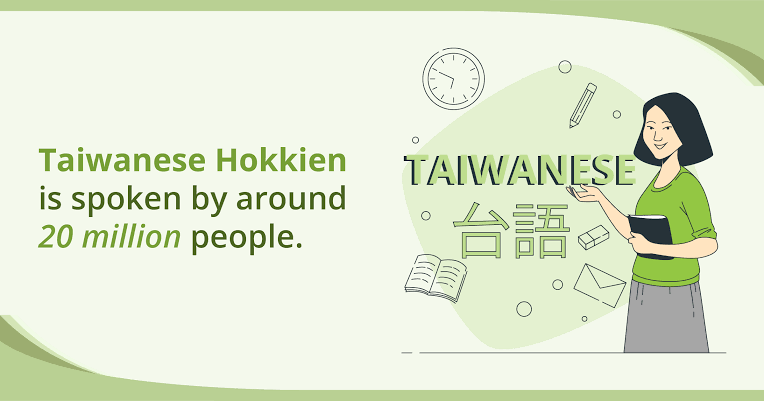
For many Taiwanese, the language that feels most intimately “Taiwanese” is Taiwanese Hokkien, also called Taiwanese, Taigi (臺語), Holo, or Southern Min. It is a variety of the Hokkien (Southern Min) language that originated in southern Fujian province in mainland China. Large numbers of Hoklo (Hokkien-speaking) immigrants settled in Taiwan from the 17th century onward, making it the most widely spoken native language for generations.
Estimates indicate that Taiwanese Hokkien is spoken as a first or second language by a large majority of the population—often cited around 70–80 percent in various surveys and census-related data. It remains especially strong in southern and central Taiwan and in more informal, family, and community settings. In northern cities and among younger generations, however, its everyday use has declined as Mandarin has become the default in schools, workplaces, and media.
Taiwanese Hokkien is not fully mutually intelligible with Mandarin. It has a different phonology (including more tones in some analyses), distinct vocabulary, and its own grammatical patterns. It has also absorbed influences from indigenous languages, Dutch, Japanese, and later Mandarin. Writing systems include Pe̍h-ōe-jī (a Romanization developed by missionaries), various Chinese-character-based systems, and more recent standardized orthographies promoted by the government.
Hakka: The Language of a Distinct Community
Hakka (客語, Kejia) is another Sinitic language spoken by the Hakka people, who form a significant ethnic minority in Taiwan (roughly 10–20 percent of the population by ancestry, though active speakers are fewer). Hakka communities are concentrated in areas such as Taoyuan, Hsinchu, Miaoli, and parts of southern Taiwan. Several dialects exist in Taiwan, with Sixian and Hailu being among the most prominent.
Like Hokkien, Hakka is not mutually intelligible with Mandarin or Taiwanese Hokkien. It has its own phonetic system, tones, and vocabulary. Government data and surveys typically show Hakka spoken at home by around 5–7 percent of the population in older census figures, with higher figures for ethnic identification. Younger generations often have stronger proficiency in Mandarin, leading to concerns about intergenerational transmission.
Indigenous Formosan Languages: Austronesian Roots of the Island
Long before Han Chinese settlement, Taiwan was home to Austronesian-speaking indigenous peoples. Their languages, collectively known as Formosan languages, are of enormous historical and linguistic importance. Taiwan is widely regarded by linguists as the homeland (Urheimat) of the entire Austronesian language family, which later spread across the Pacific and Indian Oceans to places as far as Madagascar, Hawaii, New Zealand, and Easter Island. The Formosan languages represent multiple primary branches of Austronesian, showing deep internal diversity.
Today, the government officially recognizes 16 indigenous groups and their languages (with additional dialects and some related varieties). These include Amis (the largest by number of speakers), Atayal, Bunun, Paiwan, Rukai, Puyuma, Tsou, Saisiyat, Yami/Tao (spoken on Orchid Island and related to Philippine languages), and others such as Seediq, Truku, Kavalan, Sakizaya, Thao, Kanakanavu, and Saaroa. Indigenous peoples make up roughly 2.3–2.6 percent of Taiwan’s population (over 600,000 people in recent figures). However, only a minority remain fluent speakers of their ancestral languages due to centuries of language shift under successive regimes. Many of these languages are endangered or critically endangered.
Efforts to revitalize them include official recognition as national languages, school programs, media (such as indigenous television), and community initiatives.
Other Languages and Varieties
Additional varieties appear in specific places. On the Matsu Islands, Eastern Min (related to the Fuzhou dialect) is spoken. Kinmen has its own Southern Min characteristics. Taiwan Sign Language is also recognized as a national language. Immigrant communities from Southeast Asia (Indonesia, Vietnam, the Philippines, Thailand, and others) have introduced languages such as Indonesian, Vietnamese, Tagalog, and Thai, reflecting the presence of hundreds of thousands of new residents and migrant workers. Japanese retains some residual influence among older generations educated during the Japanese colonial period (1895–1945), and English is widely taught as a foreign language.
Historical Trajectory of Language Use
Taiwan’s linguistic landscape has been repeatedly reshaped by external powers and internal policies.
Indigenous Austronesian languages were spoken for millennia. Dutch and Spanish colonial presence in the 17th century had limited long-term linguistic impact beyond missionary work and some early writing systems. Large-scale Han settlement under the Qing dynasty brought Hokkien and Hakka speakers, who became demographically dominant in the western plains while indigenous groups were pushed into mountainous and eastern areas or assimilated.
Japanese colonial rule (1895–1945) promoted Japanese as the language of education and administration, especially in later decades. After 1945, when the Republic of China took control, the Kuomintang government implemented a strong Mandarin-only policy. Local languages were discouraged or prohibited in schools and official settings; students could face penalties for speaking them. This policy accelerated the shift toward Mandarin, particularly among younger generations born after the 1950s. Martial law (1949–1987) reinforced the monolingual approach.
Democratization from the late 1980s onward reversed this trajectory. The Mother Tongue Movement and political liberalization elevated local languages. Key legislation includes the Indigenous Languages Development Act (2017) and the Development of National Languages Act (2018/2019), which granted national language status to Mandarin, Taiwanese Hokkien, Hakka, Formosan languages, Taiwan Sign Language, and others. Local languages are now taught in schools, appear in public announcements (often quadrilingual: Mandarin, Hokkien, Hakka, and English), and receive government support for media and cultural production.
Current Language Use and Generational Patterns
Census and survey data reveal a clear pattern of language shift. Older census figures (around 2010) showed high rates of home use for both Mandarin and Hokkien (often overlapping, as many households are multilingual). More recent surveys indicate that Mandarin has become the primary language spoken at home for a majority (around 68–70 percent or higher in some studies), while active daily use of Hokkien has fallen, especially among younger people. One 2024 survey found that while a large majority identify with Hoklo heritage, only about 30 percent reported speaking Hokkien at home. Use of Hakka and indigenous languages is even more limited among the young.
This does not mean the local languages have disappeared. Code-switching is common in daily conversation—people mix Mandarin and Hokkien fluidly. Southern Taiwan retains stronger Hokkien use. Media, music, politics, and cultural events continue to feature local languages prominently. The challenge is primarily one of transmission: children who grow up speaking mostly Mandarin at home and school may understand Hokkien or Hakka but use them less actively.
Education, English, and Future Directions
Language education has evolved from strict Mandarin monolingualism to greater pluralism. Local languages (Hokkien, Hakka, indigenous languages, and others) are part of the curriculum. English has long been the main foreign language and is introduced early. The government has pursued a “2030 Bilingual Nation” policy aimed at strengthening English proficiency alongside Chinese, with goals for bilingual instruction in schools and greater use of English in public life. Implementation has faced practical challenges, including teacher training and concerns about balancing English promotion with mother-tongue education.
Cultural and Political Significance
Language in Taiwan is closely tied to identity. For some, Mandarin represents modernity, national unity, and connection to broader Chinese culture. For others, Hokkien, Hakka, and indigenous languages embody local Taiwanese identity, resistance to earlier assimilation policies, and cultural distinctiveness. Debates over language names, orthography, education hours, and public usage continue to reflect broader questions about Taiwan’s history and future.
Public transportation announcements, street signs, television, popular music, and political campaigning often reflect this multilingual reality. Traditional characters remain the standard, reinforcing a visible distinction from mainland China.
Conclusion
People in Taiwan primarily speak Taiwanese Mandarin as the shared language of public life, education, and intergroup communication. At the same time, Taiwanese Hokkien remains deeply rooted in family and cultural life for a large portion of the population, Hakka continues as the language of a distinct community, and indigenous Formosan languages preserve an ancient Austronesian heritage of global linguistic significance. Immigrant languages and English add further layers.
Taiwan’s language situation is not static. Policies now formally recognize linguistic diversity after decades of monolingual pressure. Whether local languages reverse their decline among younger generations depends on family practices, education quality, media representation, and continued social valuation of multilingualism. The island’s linguistic diversity is both a product of its layered history and a living resource that continues to shape Taiwanese society, culture, and identity.