Steam console release date: Everything About Valve’s Living-Room Gaming PC (June 29/30, 2026 Launch)

 Reviews
steam console release date
Valve’s long-awaited return to living-room hardware finally arrived in summer 2026. The device commonly called the “Steam Console” by media and fans is officially the Steam console release date—a compact, silent, cube-shaped gaming PC that Valve repeatedly insists is not a traditional console. Announced on November 12, 2025, alongside a redesigned Steam Controller and the Steam Frame VR headset, the Steam Machine began shipping to reservation holders starting June 29–30, 2026.
This article covers the full story: the exact release timeline and how the reservation system worked, detailed specifications and real-world performance, design and living-room features, the painful history of the original 2015 Steam Machines, why the new version is different, pricing controversies driven by the “RAM-ageddon,” comparisons to PlayStation 5 / PS5 Pro and Xbox Series X, software strengths and limitations, and what it means for PC gaming in the living room.
Official Steam console release date and How to Buy
Valve first targeted an “early 2026” launch when the hardware was revealed in November 2025. Component shortages—especially DRAM and storage driven by AI data-center demand—forced a delay. In February 2026, Valve publicly acknowledged it needed to revisit both pricing and the shipping schedule while still aiming for the first half of the year.
On June 22, 2026, Valve confirmed concrete details: reservations opened immediately, a one-time randomization of the queue occurred on June 25, and the first purchase invitation emails went out the week of June 29. Units began shipping around June 29–30, 2026. There was no single global “day one” flood of stock. Instead, Valve used a lottery-style reservation system (requiring a Steam account in good standing with a prior purchase before a cutoff date) to reduce scalping, similar to the approach used for the second-generation Steam Controller. Selected buyers received a 72-hour window to complete purchase; everyone else joined a waitlist for later batches. Valve aimed to fulfill the initial reservation queue by the end of 2026.
As of September 2026, the Steam Machine is available through this phased process rather than unlimited open stock at major retailers. New inventory continues to be allocated via the waitlist.
Pricing and Configurations
The price was the biggest surprise—and the biggest source of criticism. Valve had hoped for more console-like pricing, but memory and storage costs pushed the final figures higher.
- 512 GB model: $1,049 (approximately €1,039 / £879)
- 512 GB + Steam Controller: $1,128
- 2 TB model: $1,349
- 2 TB + Steam Controller: $1,428
The 2 TB version includes extra magnetic faceplates (red fabric and solid walnut). Valve has been open that the device is sold closer to cost than traditional consoles, which are often subsidized by software and services revenue. The company explicitly frames the Steam Machine as an extension of PC gaming rather than a closed console ecosystem.
Design and Living-Room Features
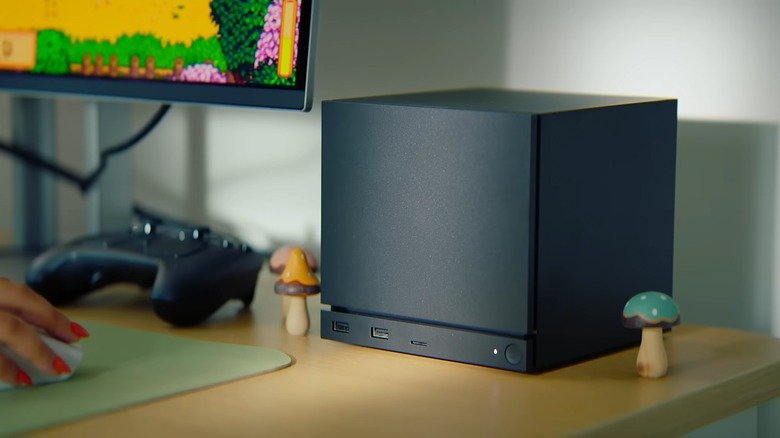
The Steam console release date is a roughly 6-inch (about 156 × 152 × 162 mm) cube weighing around 2.6 kg / 5.7 lb. It is deliberately compact enough to sit under a TV or on a media shelf without dominating the space. An internal power supply eliminates the external brick common on many mini-PCs. A customizable 17-LED RGB light bar on the front displays download progress, system status, or user-chosen effects; a red pattern signals errors (echoing the old Xbox “red ring of death”). Magnetic faceplates allow easy cleaning and cosmetic swaps.
Key living-room conveniences include:
- HDMI-CEC support so the Machine can power on the TV, switch inputs, and shut everything down when you finish.
- Instant wake from the Steam Controller (or compatible controllers).
- Background downloads and updates that continue even when the display is off.
- Quiet operation under normal gaming loads (reviewers frequently praise the near-silent thermals).
I/O is practical: DisplayPort 1.4 (up to 4K/240 Hz or 8K/60 Hz with HDR and FreeSync), HDMI 2.0 (up to 4K/120 Hz with HDR, FreeSync, and CEC—later refined toward fuller HDMI 2.1 features via driver work), Gigabit Ethernet, Wi-Fi 6E, Bluetooth 5.3, multiple USB-A ports, one USB-C, a high-speed microSD slot (compatible with Steam Deck / Steam Frame cards), and a dedicated 2.4 GHz radio for the Steam Controller.
Detailed Specifications
Valve uses semi-custom AMD silicon rather than off-the-shelf desktop parts:
- CPU: 6-core / 12-thread Zen 4 (mix of full Zen 4 and efficiency Zen 4c cores), up to 4.8 GHz, 30 W TDP.
- GPU: RDNA 3 (Navi 33-derived), 28 compute units, up to 2.45 GHz sustained, 110 W TDP, 8 GB GDDR6.
- System RAM: 16 GB DDR5 (single SODIMM, upgradeable in theory).
- Storage: 512 GB or 2 TB NVMe (M.2 2230/2280 compatible); microSD expansion.
- OS: SteamOS 3 (Arch Linux-based) with KDE Plasma desktop mode. Windows drivers were released so users can install Windows if desired.
Valve marketed the Machine as roughly six times more powerful than the Steam Deck and capable of “4K gaming at 60 fps with FSR.” Independent testing placed GPU performance roughly between an RX 6600 and a cut-down RX 7600 / RTX 3060 class, with the stronger Zen 4 CPU often outperforming the older Zen 2 cores in the base PS5 in CPU-bound scenarios.
Real-World Performance
In practice the Steam Machine delivers solid 1080p high/ultra experiences and competent 1440p or upscaled 4K with AMD FSR. Native 4K without upscaling is limited by the 8 GB VRAM and overall GPU power; heavy ray-traced titles require significant compromises. Reviewers noted stable frame rates that pair especially well with VRR TVs. Thermals and noise are excellent for a sealed cube. Some anti-cheat systems that demand kernel-level access remain problematic on SteamOS (a limitation shared with the Steam Deck).
Compared with contemporary consoles:
- It sits near base PS5 / Xbox Series X levels in many rasterization scenarios and benefits from a more modern CPU architecture and better upscaling (FSR 3/4 path).
- The PS5 Pro’s higher compute unit count, unified memory, and PSSR upscaler generally deliver stronger native 4K and ray-tracing performance at a lower street price.
- The openness of the Steam library (hundreds of thousands of titles via Proton compatibility), mod support, desktop mode, and ability to install other launchers (via tools such as Heroic) are the Machine’s clearest advantages.
Why the Original Steam Machines Failed (and Why This One Is Different)
The 2015 Steam Machines were a fragmented effort: multiple OEMs built varied hardware running an early, immature SteamOS that lacked a robust compatibility layer. Game support was limited to native Linux titles, performance often lagged Windows, and there was no strong “reference design” from Valve itself. Sales were poor (well under a million units), and the initiative faded.
The 2026 Steam Machine addresses every major weakness. Valve designs and sells a single, consistent hardware platform. SteamOS 3 + Proton (matured on the Steam Deck) runs the vast majority of the Windows Steam library with high compatibility. The form factor, power delivery, silent cooling, CEC integration, and controller wake features are purpose-built for the living room. The Deck’s success proved the software stack; the Machine simply scales that experience to a higher performance tier without the battery and thermal constraints of a handheld.
Broader Context and Outlook
The Steam console release date arrives at a moment when console generations are aging (Series X and base PS5 are several years old) and PC gaming continues to grow. Its high price relative to subsidized consoles is the primary barrier. For players who already own large Steam libraries, value mods, dislike closed ecosystems, or want a quiet mini-PC that can also serve as a desktop, it is compelling. For pure cost-per-frame or exclusive-driven console buyers, a PS5 Pro or Xbox remains cheaper and often stronger in optimized first-party titles.
Valve continues shipping units in batches through late 2026. Third-party accessories (custom faceplates with E-Ink or RGB matrices, for example) have already appeared. Windows support, ongoing SteamOS updates, and the shared microSD ecosystem with the Deck and Frame give the platform longevity. Whether a future, more affordable revision or a true next-generation Steam Deck arrives will depend on component costs and silicon progress—Valve has repeatedly said it is waiting for a genuine generational leap before committing to Deck 2.
In short, the Steam Machine’s release date of late June 2026 marks Valve’s most serious, fully controlled attempt yet at bringing the full PC gaming experience into the living room. It is expensive, deliberately not a closed console, and highly capable within its performance envelope. For many Steam users, it is the device they have been waiting more than a decade to see.