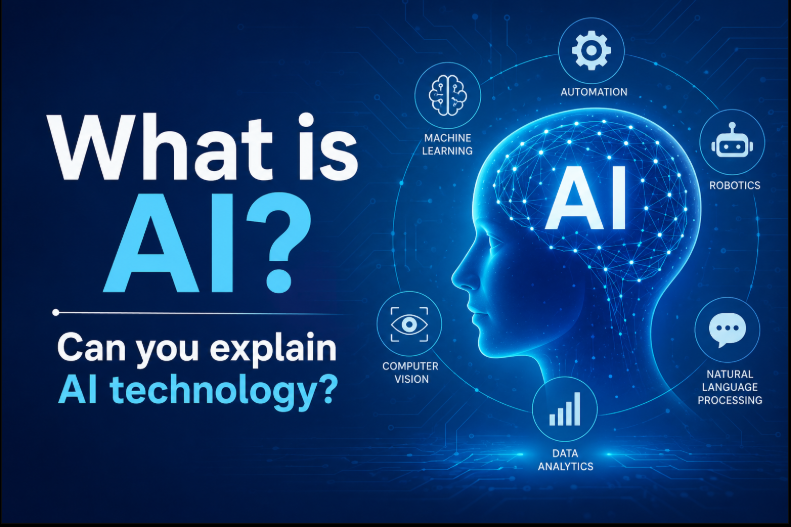
What is AI? Can you explain AI technology?

 📱 Tech News
What is AI? Can you explain AI technology?
Artificial intelligence surrounds us every day. It powers the recommendations you see on streaming platforms, helps doctors read medical scans faster, and even supports teachers in personalizing lessons. Yet many people still ask the same basic question: What is AI, really?
This guide answers that question in plain language. You will learn how AI technology works, why Artificial Intelligence Education matters for students and professionals in India and the United States, and how to use these tools responsibly. No jargon walls. No hype. Just clear explanations grounded in how the technology actually functions today.
What is Artificial Intelligence?
Artificial intelligence is the field of computer science focused on creating systems that can perform tasks that normally require human intelligence. These tasks include understanding language, recognizing patterns in images, making decisions from data, and adapting to new information.
Think of AI as a set of tools that let machines learn from examples rather than following only rigid, pre-written instructions. A traditional program follows exact rules. An AI system improves its performance by analyzing large amounts of data.
The term “AI” covers a wide range of capabilities. Some systems are narrow: they excel at one specific job, such as translating text or detecting fraud in banking transactions. Others aim for broader reasoning abilities. Most of the AI you encounter in 2026 falls into the narrow category, often called specialized or applied AI.
How Does AI Technology Work?
At a high level, modern AI systems follow a learn-predict-improve cycle.
- Data collection – The system receives examples (text, images, numbers, sensor readings).
- Training – Algorithms adjust internal parameters so the system can map inputs to useful outputs.
- Inference – Once trained, the system applies what it learned to new, unseen data.
- Feedback and refinement – Performance is measured, and the model is updated when needed.
Most current systems rely on machine learning, a subset of AI in which computers improve through experience. Deep learning, a further subset, uses multi-layered neural networks inspired by the structure of the human brain. These networks process information through successive layers of mathematical transformations.
The quality of results depends heavily on the quality and quantity of training data, the design of the model, and the computing resources available. Better data and careful engineering produce more reliable outcomes.
Core Techniques Behind Modern AI
Several techniques form the foundation of today’s systems:
- Supervised learning – The model learns from labeled examples (for instance, thousands of photos already tagged as “cat” or “dog”).
- Unsupervised learning – The system finds hidden patterns in unlabeled data, useful for customer segmentation or anomaly detection.
- Reinforcement learning – The model learns by trial and error, receiving rewards or penalties for its actions. This approach powers many game-playing and robotic systems.
- Natural language processing (NLP) – Techniques that allow machines to understand, generate, and translate human language.
- Computer vision – Methods that enable systems to interpret images and video.
These Artificial Intelligence Techniques often combine. A single application might use computer vision to read a document and NLP to extract meaning from the text.
Artificial Intelligence Education: Why It Matters
Artificial Intelligence Education has become essential for both students and working professionals. In India and the United States, demand for people who understand how these systems work continues to grow across healthcare, finance, manufacturing, education, and government.
Learning AI does not require a PhD. Foundational courses cover statistics, basic programming (often Python), data handling, and core machine-learning concepts. Many universities, online platforms, and community colleges now offer structured pathways. Practical projects—building a simple image classifier or analyzing public datasets—build real skill faster than theory alone.
For educators, Artificial Intelligence Education also means learning how to use AI tools responsibly in the classroom. Adaptive learning platforms can adjust difficulty for individual students. Automated grading of objective questions frees teachers to focus on higher-order feedback. At the same time, teachers need to understand limitations so they can guide students away from over-reliance on generated answers.
In both India and the US, governments and industry groups have emphasized digital literacy that includes AI awareness. Understanding the technology helps citizens evaluate claims, protect personal data, and participate in discussions about regulation and ethics.
Real-World Applications Across Industries
AI technology already delivers measurable value in several domains:
Healthcare Systems assist radiologists by highlighting potential abnormalities in scans. Predictive models help hospitals anticipate patient flow. Drug-discovery research uses AI to narrow promising chemical compounds.
Education Personalized tutoring systems adapt to a student’s pace. Language-learning apps provide instant pronunciation feedback. Administrative tools automate scheduling and attendance tracking.
Business and Finance Fraud-detection models flag unusual transactions in real time. Supply-chain systems forecast demand more accurately. Customer-service chatbots handle routine inquiries so human agents can focus on complex cases.
Transportation and Logistics Route-optimization algorithms reduce fuel use and delivery times. Predictive maintenance systems alert operators before equipment fails.
These examples illustrate applied, narrow AI. They solve specific problems rather than attempting general human-level intelligence.
Pros and Cons of AI
Advantages
- Handles large volumes of data faster than humans
- Improves consistency in repetitive tasks
- Enables personalization at scale
- Supports scientific discovery by identifying patterns humans might miss
- Can increase accessibility (for example, real-time captioning or translation)
Limitations and Risks
- Performance depends on training data quality; biased data produces biased results
- Many systems lack transparency (“black-box” problem)
- High energy use during training of large models
- Potential job displacement in certain routine roles
- Risk of over-reliance or misuse (deepfakes, automated misinformation)
- Privacy concerns when systems process personal information
Balanced adoption requires ongoing evaluation of both benefits and drawbacks.
Expert Tips for Learning and Using AI
- Start with fundamentals. Solid understanding of data, basic statistics, and programming beats jumping straight into advanced tools.
- Build small projects. A working prototype teaches more than passive video watching.
- Focus on domain knowledge. AI skills combined with expertise in healthcare, education, or finance create stronger career paths.
- Evaluate sources carefully. Prefer documentation from established research labs, peer-reviewed papers, and reputable educational platforms over marketing claims.
- Practice responsible use. Always check AI-generated content for accuracy, especially in professional or academic settings.
- Stay current without chasing every new release. Core principles change more slowly than product names.
- Collaborate across disciplines. Engineers, domain experts, and ethicists together produce better outcomes than any single group working alone.
Common Mistakes to Avoid
- Treating AI as magic rather than engineered systems that require careful data and testing
- Ignoring data quality and bias
- Expecting one model to solve every problem
- Deploying systems without monitoring for drift or unexpected behavior
- Using AI-generated text or code without verification
- Overlooking privacy and security implications
- Assuming that larger models are always better for every task
Awareness of these pitfalls improves both learning speed and real-world results.
Frequently Asked Questions
What is the difference between AI, machine learning, and deep learning? AI is the broadest term. Machine learning is a subset in which systems improve from data. Deep learning is a further subset that uses multi-layered neural networks.
Do I need advanced mathematics to understand AI? Basic linear algebra, probability, and calculus help, but many practical courses introduce concepts gradually. Strong problem-solving skills and curiosity matter more at the beginning.
Is AI going to replace teachers or doctors? Current systems assist rather than replace. They handle routine analysis so professionals can focus on judgment, empathy, and complex decision-making.
How can students in India or the US start learning AI? Begin with free introductory courses from recognized universities or platforms, practice with public datasets, and join local study groups or online communities. Many colleges now offer formal certificates and degrees.
What should I look for when evaluating an AI tool? Check the quality of training data (if disclosed), transparency about limitations, privacy practices, and independent evaluations rather than only marketing claims.
Conclusion
AI technology is a collection of methods that enable computers to perform tasks once limited to human intelligence. From pattern recognition to language understanding, these systems already support education, healthcare, business, and daily life in both India and the United States.
Artificial Intelligence Education equips people to use these tools effectively and responsibly. Understanding the underlying techniques, strengths, and limitations helps individuals and organizations make better decisions.
The most useful path forward combines technical literacy with critical thinking. Learn the fundamentals, experiment with real projects, evaluate results carefully, and stay mindful of ethical considerations. That approach turns curiosity about “What is AI?” into practical capability.
Call-to-Action
If you found this explanation helpful, explore a reputable introductory course or try building a small project this week. Share the article with colleagues or students who are also asking the same foundational questions. Clear understanding is the best starting point for responsible use of artificial intelligence technology.